
Primavera 2026
A development program for emerging writers designed to accompany MCA Australia’s exhibition Primavera 2026: Young Australian Artists.
27 June – 10 September 2026
Museum of Contemporary Art Australia and The Power Institute
The 2026 cohort comprises of eight current students and recent graduates of the University of Sydney, mentored by curator Antares Wells (MCA Australia) and writers Nick Croggon and Daniel Browning (The Power Institute, University of Sydney). The program includes a series of events from June to September 2026, including artist talks, writing workshops, reading groups and studio visits.
Mentors


Participants

Linda Sok’s Deities in Temples & Jack Wansbrough’s Meteorite Enquiries
Must the archive always be a death sentence? A thing, to paraphrase Saidiya Hartman, of commodities and corpses?[1] It is a question that haunts Primavera 2026: Young Australian Artists, whose opening wall has been graced by a myriad of mementos – an assembly that curator Antares Wells has drawn together, having invited each of the show's eight artists to display the catalysing 'spark' behind their main contributions. Of these, two draw my particular attention: a copy of a yellowed museum registration card from 1920s Cambodia, and an unassuming rock. A quick glance at the exhibition catalogue reveals that the latter arrived from Telfer, Western Australia; its age is listed as over a billion years old. These objects are the antecedents of sculptural works by Linda Sok and Jack Wansbrough, both of whom are engaged in a service of substitution, their art offering stand-ins, or false selves, for materials either absent or rejected from the archive.
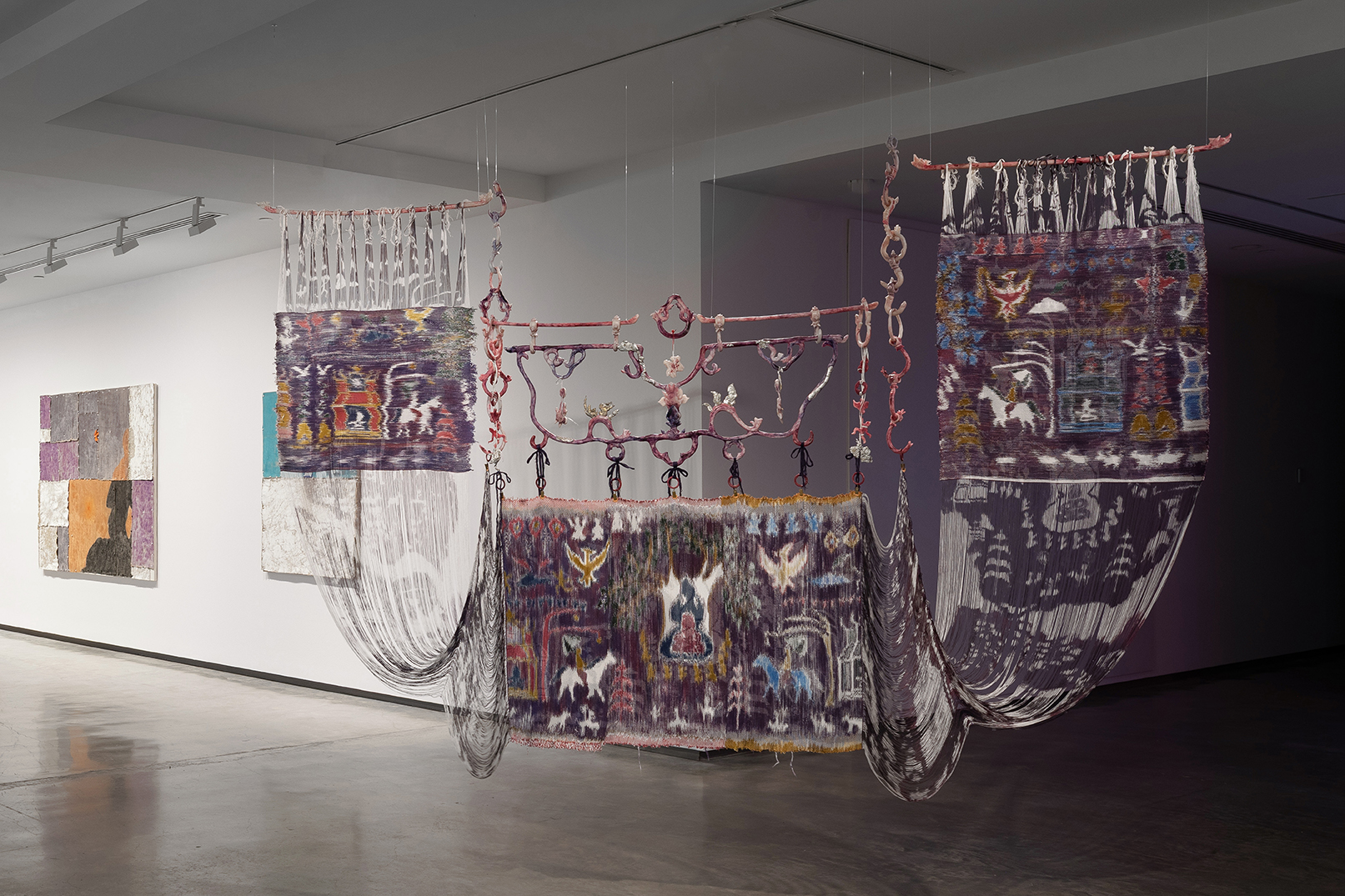
In the centre of the gallery hangs a cascade of muted silk, suspended in midair by hooks of air-dried clay, its ikat-dyed body crowded with scenes from Buddhist scripture. White and blue horses canter across the edges of the piece, saddled by abstracted riders; the divine bird Garuda alights with its wings outstretched; the figure of the Buddha is circled by miniaturised worshippers. Deities in Temples XXI (2026) is a Pidan weaving by Linda Sok, a ceremonial silk cloth typically affixed to the ceiling in temples, and one belonging to a matrilineal Cambodian tradition that, in the 1970s, was decimated by the genocidal regime of the Khmer Rouge – the same regime that forced the immigration of Sok’s family to Australia, and which murdered over two million people. Sok’s work is a reimagining of the possible appearance of one suspected casualty of this time, a Pidan belonging to the National Museum of Cambodia.
The aforementioned museum registration card stands as the only surviving evidence of this specific weaving's existence, yet it is a document marred by its operation as an instrument of colonial ethnography. Written by French cataloguer George Groslier during the French occupation, the card is little more than three cursive sentences, utterly lacking any cultural or sacred sensitivity. His remarks are limited to the cloth's size, economic value, as well as the description of such imagery as 'divinités dans des chapelles' – 'deities in temples.' It is a 'meagre sketch of her existence,' to invoke Michel Foucault, the card claiming total authorial truth over a tradition unable, through its original materials, to represent itself.[2] Hence, the question must become: How may we return to a destroyed, lost artefact its own cultural voice?
When we observe Sok's sculptural-textile piece, we see a cloth flayed apart in areas, an open warp leaving the silk threads unwoven, unraveled. Void of colour, the threadbare lines cast ghostly pictorial silhouettes, the work's negative spaces perhaps hinting at the severance in the chain of generational knowledge caused by the devastation of war, and the impact of this disruption on the diasporic communities that emerged in its wake. This sense of diasporic break, yet also the innate regeneration and continuation of this piece, are made profound by the design itself. Having handed over a translation of the museum's registration card alongside a prompt to draw how they believed the weaving may have looked, Sok's parents sketched the sigil of a tree, featured in the Primavera work extending out behind the seated Buddha. It is an image completely unmentioned in Groslier's document, perhaps deemed an unnecessary detail – and yet, in a moment of immense serendipity during a trip to Cambodia, Sok discovered the motif to frequently appear on Pidan weavings.[3] In this there is instigated a gap, an elevation of her familial memory over the reduction of colonial interpretation, a reclamation, resurrection that testifies to what Hartman describes as the 'resistance of the object.'[4] Sok has liberated the Pidan from the stasis of its antiquated, formal museum record, and she has done so by privileging the recollections of her family and their cultural experiences. Personal rather than encyclopedic, felt rather than observed: for Sok, it is absence, not necessity, that is the mother of invention, of reinvention.
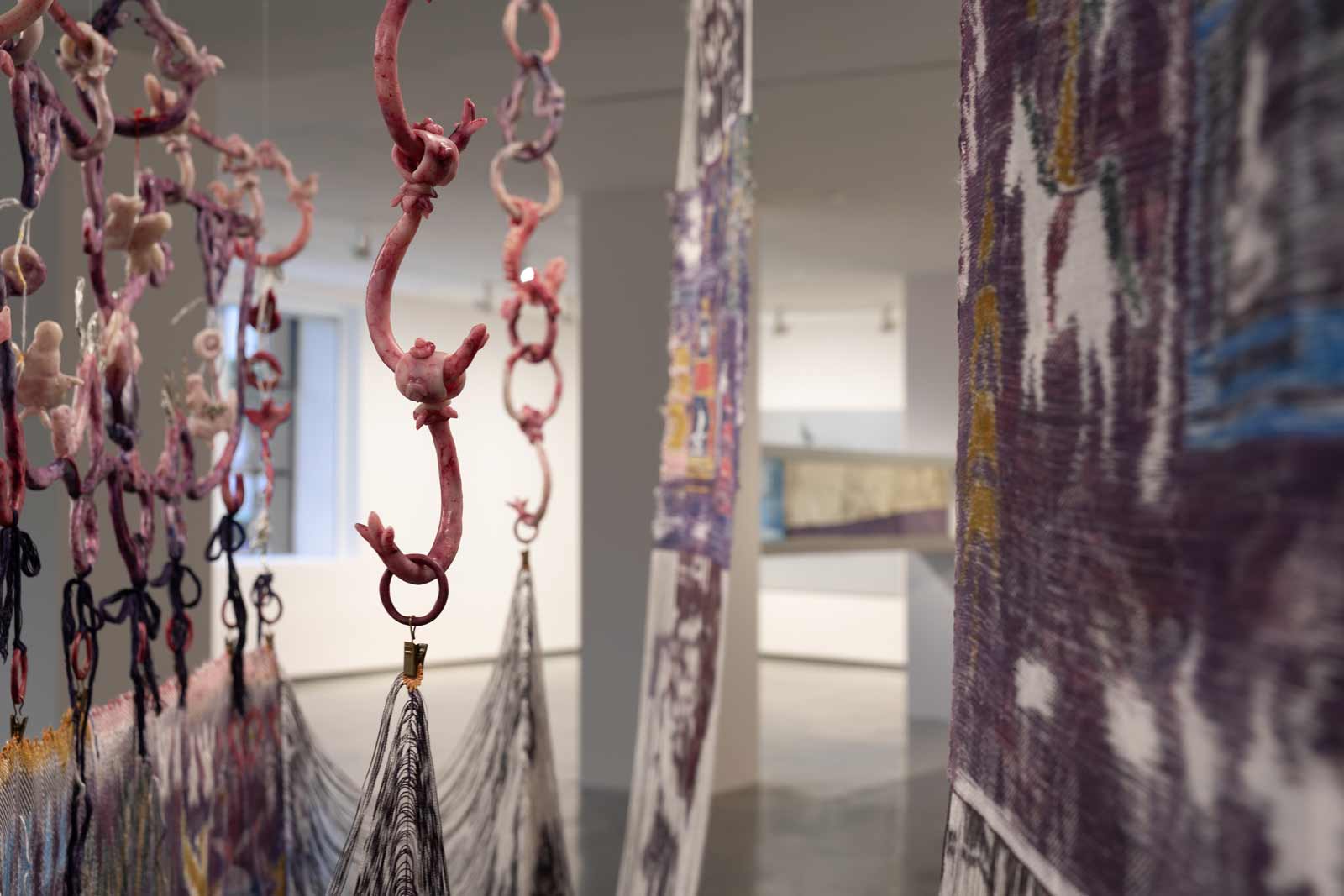
To linger a moment more on its suspension: Deities in Temples XXI is hung in place with the hooks of a surreal palanquin in pink and silver. The silver comes from pewter casting, rendered using imperfect sand molds by pressing in figural models of air-dried clay. As Sok describes, 'they are copies of copies, molds/mother molds that grow their own interpretation of that that they should be.'[5] As the twenty-first in the series, there is an undeniable element of regrowth to this piece, an attention to the agency of the practice itself as a living tradition. Its colours bleed from the reds described in the document across iterations into pink, each one informing the next – and in continuing, changing, the work seeks to articulate a method for the diaspora to reconnect with their artistic heritage.
This material biography is made all the more remarkable through the clay's preservation of the artist's fingerprints – a literal embedding of her identity and cultural self within the narrative of the Pidan weaving. The clay ornamentation is rendered across the hooks in floral loops and figures, reflecting amulets hung within a temple context, yet when attached to lengths of silk they appear as bones – support beams of femurs that act as a memento mori, a macabre heralding back to the violence inflicted on the craft and its artisans.[6] Yet this only furthers the work as a site of renewal, one that curves around and resuscitates certain moments in Cambodian history for the present. Deities in Temples XXI is an imaginative false self, laying before us the lived realities of the craft at large, its traumatic erasure, and its resurrection in the diaspora. Sok's work alerts us to the notion that history is not a stable thing, but constantly in flux or growth, and hence must be revisited, overcome and reconstructed.


Across the gallery space, my eyes fall upon what appears to be the scattered obsessions of some eccentric scientist. For Jack Wansbrough’s Meteorite Enquires (2026), a low plinth on the floor has been turned into a shrine to disappointment. The work was inspired by a file found in a bin at the Western Australian Museum that documents 121 ‘meteorwrongs’ – rocks mistakenly assumed to be meteorites that had been submitted to and subsequently rejected by the museum’s Dr Alex Bevan between 1980–1995. This is an installation of painstaking substitution, replacement, reenactment. Volcanic scoria? Cast iron from a ship’s anchor? Unfortunately, unfortunately, this is malachite, magnetite, glassy slag.[7] All terrestrial, all wearily set aside. In one of his letters of rejection, Dr Bevan writes: ‘I can offer no explanation as to how the specimen came to be on the roof of your house other than it was put there by human agency.’ Oh, and the bitter sting of small encouragement as he writes: ‘in the meanwhile, keep looking for those dusty, rusty looking rocks!’[8] Wansbrough has travelled far and wide to find stand-ins for each entry listed in the file, darkening the doors of every kooky crystal shop, wandering to industrial estates, all to make present once more what he dubs a ‘tome of absent matter.’[9]
‘My work is about misplacing the charisma of meteorites onto ordinary rocks,’ says Wansbrough. He continues:
A piece of industrial waste is a false meteorite, but it's still a real piece of thing. It's matter that you could learn from, or prophesise with, or hold in wonder. My hope with putting all of these rocks in the installation is that you can engage with them as substitutes for something missing at the same time as seeing them as bits of matter with their own charm, weight, lustre, tediousness, humour, beauty, history.[10]

At its core, Meteorite Enquiries begs for the consideration of brilliant possibility. The meteorwrongs are lit from above by fluorescent lamps overlaid with stained glass, whose pattern has been taken from photomicrographs of true meteorites. This colourful light suffuses the ordinary rocks with an ethereal glow, another step in the process of transmutation that has transformed the rocks into possible meteorites, back to rocks, and then into artworks. What novelty, what hilarious endearment can be held in your hands! Even the dullest pieces of stone on this plinth, on your street, are made from the same stuff as those cosmic powerhouses – watch them transform into something lovelier and more significant simply by virtue of your scrutiny! We can ascribe such absurd, fleeting affection to these things.
It was with my sister that I first saw the exhibition; it was she who pointed out to me the gallery label, which lists the medium: '... one unknown object, three iron meteorites, one stony meteorite.' Wait a damn minute. Are there actually meteorites here? That changes everything! My sister and I crouch down to observe each rock in more detail, pointing out to each other the ones we swear have extra charm, extra shine, something extra … terrestrial. For all the love of the mundane, for all the elevation of and dedication to simple Mother Earth, the chances of looking at a fallen star remain an ever-sweet sight for sore, rock-bottom eyes.
Caught between Sok and Wansbrough's works, I'm left with the real hope that stems from giving value to the valueless, voice to the voiceless, presence to the absent. I leave with stories that escape the restraints of a handful of text; with a false self able to transcend the death of the archive.

Addressing Alternate Approaches to the Archive
Addressing Alternate Approaches to the Archive
Please be advised that the text contains the names and images of deceased First Nations Ancestors.
A handwritten poem.
A painting of a docking ship.
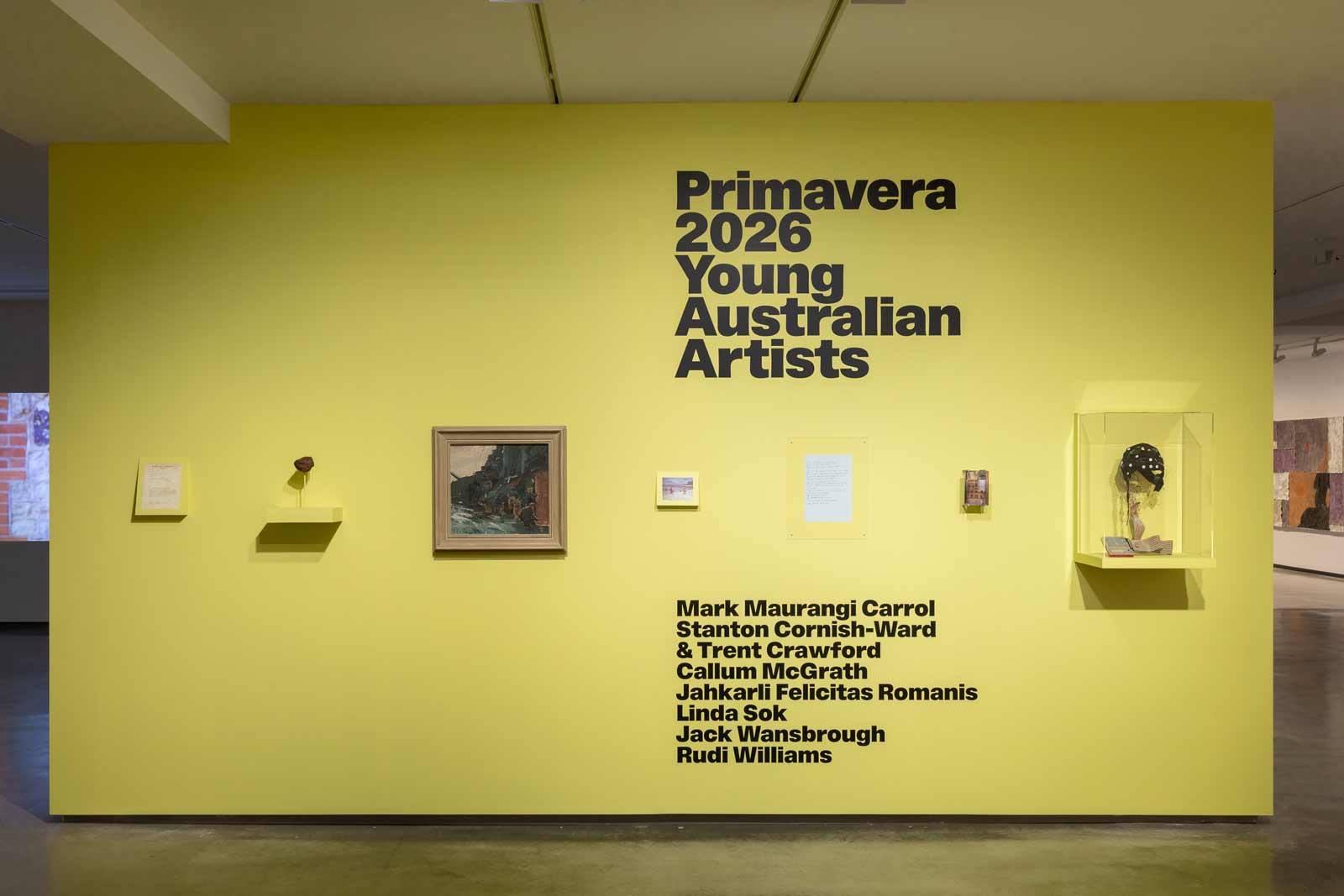
These are two of seven objects placed on the entrance wall of Primavera 2026: Young Australian Artists. Each of the artists in the exhibition was invited by curator Antares Wells to select an object which served as a 'spark' for their work. Part of an exhibition platforming artists addressing the 'residues of history,' this object wall might be thought of as a collection or an archive in of itself – an amalgamation of 'significant' fragments believed to possess a capacity for sharing meaning.[1]
The poem, written by Pitta Pitta artist Jahkarli Felicitas Romanis, is a highly intimate piece centred on Romanis's relationship with her great-grandmother, Dolly, a member of the Stolen Generation.
Selected by artist Callum McGrath, Upper deck, HMAS Australia (1943) is an oil painting of a frenetic industrial-nautical scene by Frank Norton, an official Second World War artist appointed by the Royal Australian Navy. In its focus on daily military life, this work is emblematic of 20th century Australian wartime documentary painting: a work we'd likely encounter in the Western art historical canon, as opposed to something which connects us to McGrath himself.
These two objects, very different in tone, capture the essences of Romanis and McGrath's differing approaches to engaging with 'traces' of history, and their grappling with the complexities and issues inherent within the archive, concerns which sit at the heart of Primavera 2026.[2]
Jahkarli Felicitas Romanis
In the field of Museum and Heritage Studies, in which I am a student, there is a steadily growing anxiety regarding archives, and the deeply entrenched colonial principles on which they are often built. African-American literary scholar Saidiya Hartman has argued that colonial hegemonic structures determine which artefacts, and therefore histories, are worth preserving, which has led to the gross underrepresentation of marginalised peoples within the historical record. This is the case both for large, socio-cultural histories but also smaller, more intimate ones. To counter this erasure, Hartman has proposed the practice of 'critical fabulation,' the writing of fictional stories grounded in historical fact.[3] Such work, Hartman suggests, can move beyond the excavation of historical facts, and instead recover the personalities and the textures of the lived experiences of those otherwise reduced to statistics, or whose existences have been defined, within the 'scraps' of the archive, by the violence perpetrated against them.[4]
Romanis's photographic and video work also works creatively with the gaps and erasures of the colonial archive. In an ethnographic study conducted in 1938, Dolly was photographed by anthropologist Norman Tindale. Photographs such as this, known as 'mission mugshots,' are currently located within the South Australian Museum (SAM) as part of the Tindale Genealogical Collection, however, due to a cited major collection move by SAM, Romanis was denied access to them. In Dolly (2021) and Dolly (2024) Romanis layers photographs 'taken' by Tindale, scrubbed of ethnographic markings, with her own photographs of Pitta Pitta Country. In these composite works, in which spindly tree branches extend from the nape of Dolly's neck like a network of capillaries, and stones darken the hollows of her cheeks, Dolly and Country are suggested as one, inextricably linked.
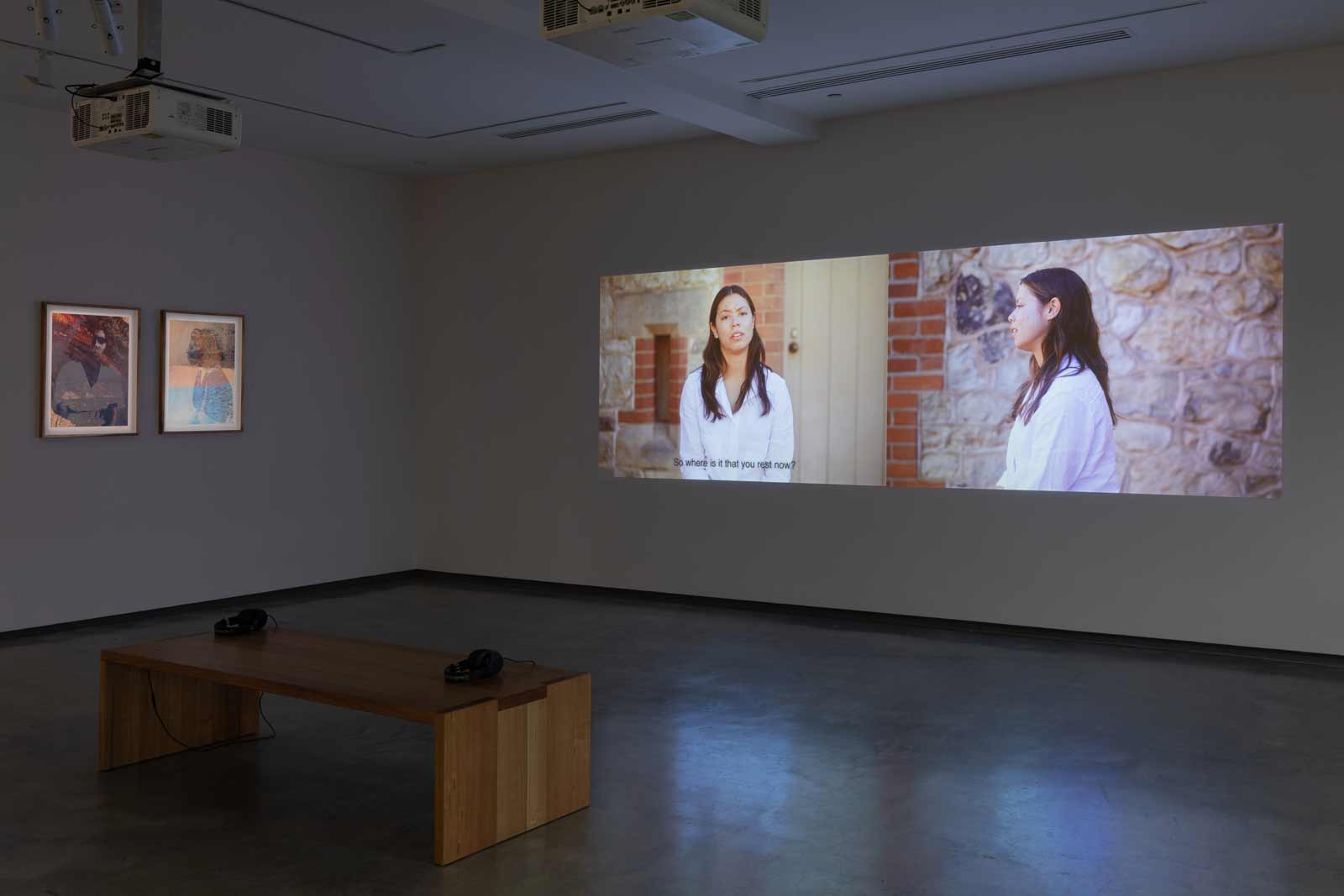
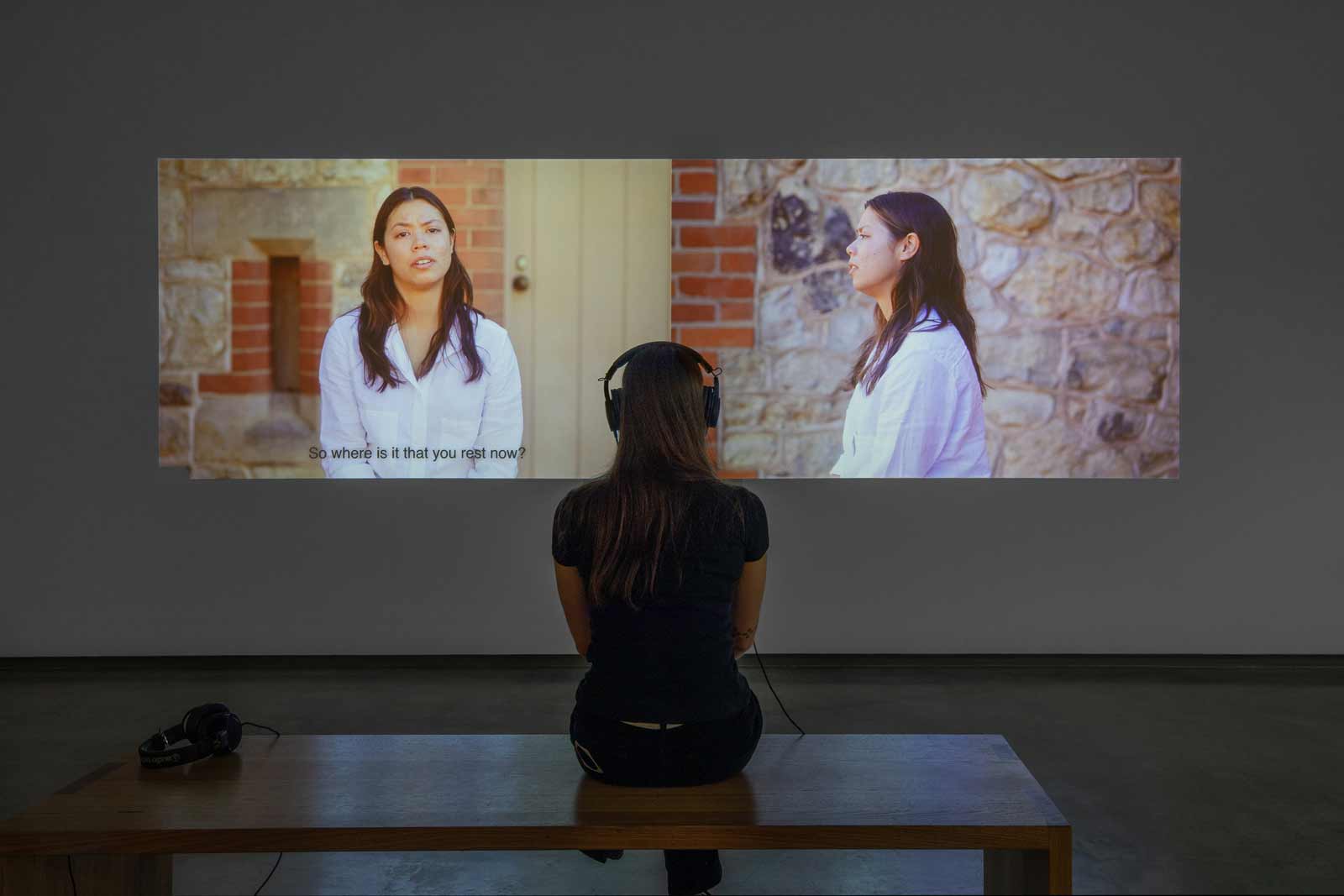
The active connection between Dolly and Romanis forms the core of Romanis's two-channel video work, Skin on Skin (2026). In this work Romanis presents two versions of herself, one front-on and another in profile, consciously mirroring the poses Dolly was made to stand in for Tindale's 'mission mugshots'. She speaks directly to Dolly, asking:
Where are you?
Are you with Harry? I really hope that you are.
By assuming the bodily positioning of Dolly, Romanis performs her connection with her great-grandmother, giving visual expression to the threads of kinship that weave between generations. In presenting herself in profile, looking to the left where the photographs of Dolly sit, Romanis seems to speak directly to Dolly, while at the same time generously allowing the audience to listen in to the conversation. Ultimately, the relationship between Romanis and Dolly is represented as alive – ongoing and traversing temporality.
Skin on Skin reminds me of Hartman’s critical fabulation – the practice of diving into and through the archive to give voice to the intimacies it suppresses. And yet Romanis’s work also offers a powerful corrective to Hartman’s influential approach. For Hartman, critical fabulation is necessitated by an understanding of history as marred by irreparable loss and broken connection, just one of the traumatic legacies of the trans-Atlantic slave trade with which her work is primarily concerned. Romanis’s works, by contrast, offer a Pitta Pitta and First Nations conception of history defined not by absence and loss, but by connection. Skin to Skin is not a work of fabulation, but rather a making visible of a strong, keenly-felt co-presence of past and present, sustained by Country, family and Romanis’s own work of research. In her poem presented at the exhibition entrance, Romanis’s final lines express this with an elegant simplicity:
Here, she is Dolly, my Great - Grandmother.
Nothing more, and nothing less.
Callum McGrath
A queer love triangle. A murder. A dispute between the Australian Government and the British Crown. The historical narrative that links these elements pulsates with the promise of drama and pathos. In his work for Primavera, however, McGrath resists this affective pull, shifting his critical eye from the intimacies erased or embedded in history (so beautifully described in Romanis's work) to the presentation of that history. His installation tells its story through a complex assemblage of historical evidence. In its refined display, the tone of the work is clinical, perhaps even official, reminiscent of the supposed objectivity that archives have traditionally purported to uphold.
The history on which McGrath's work is founded is 'an intimate love triangle gone awry': in 1942, a naval officer John 'Jack' Joseph Riley was killed by his two lovers, fellow servicemen upon the HMAS Australia (II). As relayed in the exhibition catalogue, the perpetrators were sentenced to death and the legal battle evolved into a complex multi-national jurisdictional dispute. The romantic entanglement between the soldiers, divulged by one of the men on his deathbed, was erased from the official narrative of the event.
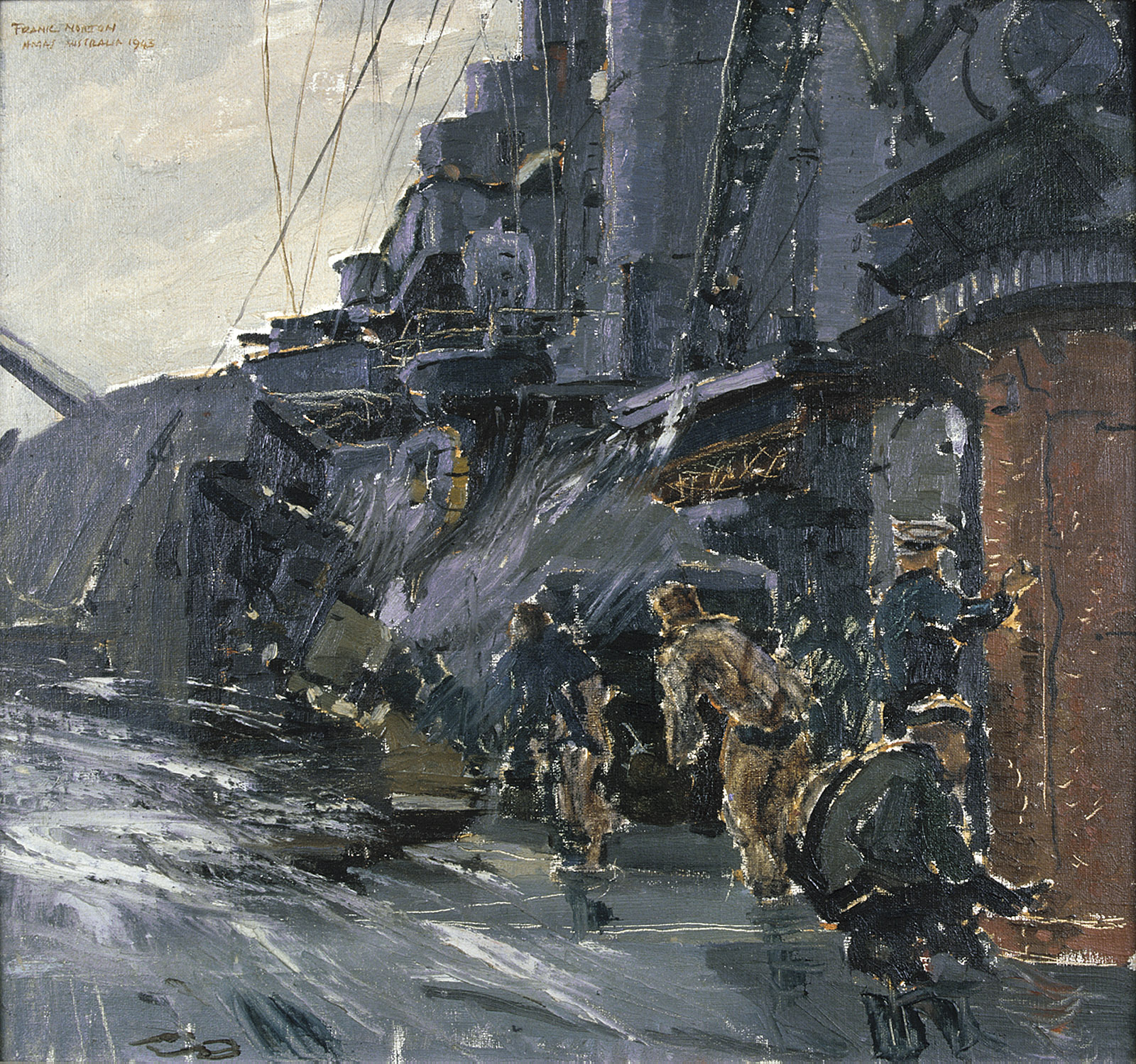
Acting as the focal point of the work is History Piece (Flagship) (2026), an ultraviolet print of a photograph held by the Australian War Memorial of a group of stokers on a ship with the iconic Harbour Bridge in the background. To the right of this work is History Piece (2026), featuring pieces of etched clear glass layered in front of each other, positioned on a custom-made shelf-like structure and attached to two permanent columns within the exhibition space. These pieces of glass are reproductions of photographic portraits, letters (found in the National Archives of Australia), and newspaper extracts (from the Sun), all traced in 'bureaucratic' blue ink.[5]

Like Romanis, McGrath reproduces and layers materials from the archive. Where Romanis's layered photographs of Dolly perform an act of rematriation, McGrath layers with the intention of creating loose ends, confusing or frustrating the viewer. When looking into the glassy abyss of documentation, glimpses of historical records are visible – a blueprint-style sketch of the Australia (II) and the outlines of a sailor uniform beneath overlapping textual excerpts – however a comprehensive review of the content is difficult to attain. As an art historian, I have been taught to look for the clues within the composition, for hints of greater conceptual meaning – here, however, I found myself stumped. Is the work about the life of John Riley? Is it a reflection upon queer naval history? A critique of the Australian Government? Or the media? It is difficult to arrive at a singular, cohesive answer, and that is the point. In replicating multiple documents and providing no associated clear message, McGrath makes transparent the impossibility of arriving at a simple explanation when engaging with the archive and the illusory nature of clean-cut historical narratives. Situated between the two permanent columns of the MCA, it is as though the institution is physically upholding these documents – a gesture, perhaps, to the historical complicity of institutions in perpetuating grand manufactured narratives.
McGrath further critiques the manufacturing of histories by leaning into the manipulation of history himself. The installation's key photograph or 'hero image,' as McGrath describes it, shows a group of naval officers that we might assume are the protagonists of McGrath's story. The location of the work (at the centre of the exhibition space) and its large size certainly suggest this. However, although found in the National Archives and belonging to the period in which the men of the true Australia (II) returned to Sydney, this image does not depict those men. McGrath notes that the key elements within the image – the 'gay' stokers, the men in positions of power standing over them – speaks enough to the truth of the story to represent it. This illustrates the ease with which history can be manufactured and makes us all the more cautious of the neat historical messaging that McGrath warns against.
McGrath's works are presented in the left corner of the gallery, opposite the only windows within the exhibition space, and through which the harbour is visible. This vista, connecting the viewer to a body of water that also witnessed Riley's murder, situates the viewer within the historical narrative and places the burden of comprehending this history on them. How will you interpret this narrative? What meaning will you glean?
Circling back to the exhibition entrance, I take another look at the object wall – at the handwritten poem by Romanis and at the oil painting selected by McGrath. What at first appeared mysterious are now markers of disparate, yet connected, pieces of archival criticism. Whether through the tender intimacy of Romanis's work or a more distanced reflexivity of McGrath's, contemporary art has a powerful ability to platform that which is typically erased from historical records, and to expose the uncomfortable historical ethics of the institutions which house them. As I cross the threshold of the gallery and wander into Circular Quay, I wonder how artists of the future will respond to the archive as we write it today, as the waters of Sydney Cove/Warrane continue to ebb and flow.

Photography and Temporality: Rudi Williams and the Air We Breathe
Photography and Temporality: Rudi Williams and the Air We Breathe
These walls once stood milky, with frames hung in ascending order of size. When Rudi Williams photographed them in Essen, Germany in 2025 and in Parkville, Victoria, 2022, the frames hung no longer. Instead, her photos show a series of white shapes on walls otherwise yellowed by cigarette smoke – indices of both the time of the frames' presence, and now their absence. In 2019 the artist purchased a piece of crimson fabric that had faded in the sun. Dark outlines of keys contrasted with the washed-out surroundings, mapping the past life of this textile.
Williams describes how her fascination with images stamped into being by the sun began in 2012 when she visited the Vatican Museum on a trip to Italy with her mother.[1] Here, she came across a room of recently emptied cabinets and observed the traces of objects imprinted on the velvet lining. Williams photographed them and later turned the images into daguerreotypes.

Williams engages deeply with the materiality of photography in her work. In the air we breathe (2026) uses historical and contemporary photographic processes to understand our relationships to loss, time and space. People have long sought ways to capture a moment, a movement, a loved one; to stave off the metamorphosis from present to past. Yet we are unable to. And this fills us with melancholy. The development of the photographic process seemed to offer a solution. With the promise of duplicating and preserving the world, moments lost could be halted and conserved. However, In the air we breathe reveals both the futile nature of these attempts, and the actuality of our ever-flowing relationship within each moment in time. Williams's photographs and found objects drag the past into the present, blending them like ink in water to reveal a recurrent state of temporality.
The photographic image and its historical development highlights the inevitability of death and change. In Words of Light: Theses on the Photography of History (1997), Eduardo Cadava writes that 'any collective or political program motivated by a will to absolute and eternal immanence is organised around the production of death.'[2] Cadava engages with writers on photography, including Walter Benjamin and Roland Barthes, who have asserted that the photograph 'certifies … that the corpse is alive, as corpse: it is the living image of a dead thing.'[3] Thus, writes Cadava, 'the possibility of the photographic image requires that there be such things as ghosts and phantoms.'[4] Working in the darkroom with light-sensitive material that draws parallels with skin, Williams acquaints herself and her audience with these phantoms. The stains, traces and residues are ghosts that have been revealed to us.

Williams's use of the daguerreotype, a suite of early photographic processes where iodine, bromine and mercury create a mirror-like image on polished silver, is another way of engaging with the phantoms of the archive and the ghosts of photographic history. Three daguerreotypes line the left-hand wall upon entry into the exhibition, showcasing interiors of the Vatican Museum. In one, a grid of crosses is visible, yet the reflective surfaces obscure the image as the viewer sees their own image reflected back at them. The absence of figures accentuates the eeriness of the photographs. Williams notes that she works in deep time – she has developed In the air we breathe over the course of more than a decade. At the Vatican in 2012, Williams desperately wanted to keep the velvet from the cabinets, but was not permitted. She bought the Sunprint purchased from Margaret Prendergast in 2019 (2025) years later. For Williams, that was karma. To me, that was the ghost's return.
As the viewer weaves in and out of the artist's installation, Williams's daguerreotypes, found photographic artefacts, and hand-printed chromogenic prints shift between visible and non-visible. This is because the endless number of positions that one can view the installation from obscure some aspects, whilst revealing others. From one position, the sunprints are not visible at all. Instead, the daguerreotypes flicker, catching the light with the movement of the eye, and the crimson dress in the far corner hangs softly, echoing the red of the velvet that keys once lay upon.
Each time I stare at Williams' work, an ember descends into the pit of my stomach. It warms me and burns me simultaneously. The hazy photographs, Cigarette Smoke II (2022), Cigarette Smoke I (2025) and Cigarette Smoke II (2025), document what once was and I find myself mourning. In her 1977 essay 'Melancholy Objects' Susan Sontag argues that time itself is the most brutally moving, irrational, unassimilable and mysterious force. Although Williams's photographs do not fit the stereotype of surrealism, In the air we breathe is surreal in its presentation of a duplicate realm where remnants of the past are laid bare. Sontag states that 'what renders a photograph surreal is its irrefutable pathos as a message from time past.'[5] Williams speaks about a process of grief in relation to a collective loss, but also in a personal sense after the loss of her father.[6] She makes herself vulnerable and then attempts to erase herself, struck by a collective grief within the world which we experience through photography. Interplaying between presence and absence, the griever is caught between realms, just like the photograph.

Many of the sunprints and photographs within Williams's installation are suspended with steel rods that span from floor to ceiling. I imagine the images sliding up and down the rods, as though floating between past, present and future. Cadava writes that photographs cast 'a future tense on the significance of what has already been written.'[7] He describes how the photographic negative is only created to be left behind. I believe this duality within photography reveals our eternal connection to all moments in time. We maintain a sort of presence of what is lost, or absent, through photography. Photography demonstrates our understanding that like all that has come before us, all will come after us too.
'Soul Eraser' in Grouper's album AIA: Dream Loss (2011) also embodies the affect that Williams's photographs evoke. Grouper's atmospheric guitar and vocals, soaked in reverb, enfold me; overcome by the murky lullaby and the phrase 'dream loss', I feel close to In the air we breathe. Nothing can be truly erased.
The moon becomes plumper and plumper as I stride beneath it. Walking the long way home through Chinatown, I buy two fried rice cake skewers and the sugar, spices and oil surge over my tongue as my teeth chew on gelatinous rice cake. My hair reeks of smoke and I think of Rudi Williams. Of her sunprints, and the skeletons of a smoke-yellowed wall that once hung with picture frames. The liminal traces of creamy walls and brighter velvet are present amongst yellowed surfaces and faded fabric. Like stepping through portals, these pieces reify each moment, resurrecting loved ones and drawing our own lives to a close.

Time is the Trace: The Work of Rudi Williams, Stanton Cornish-Ward and Trent Crawford
Time is the Trace: The Work of Rudi Williams, Stanton Cornish-Ward and Trent Crawford
Approaching Primavera 2026’s muted yellow feature wall, two of the singular objects displayed on it draw my gaze. The first, a work by Rudi Williams, is a six-by-four-inch photograph of a velvet-lined vitrine marked with the outlines of small altarpiece panels and frames. iPhone camera in hand and absorbed in its screen, I initially mistake the figure in this image as my own, but as I lower my lens, the silhouette is still. The velvet imprints of the removed objects materialise what fellow Primavera artist Trent Crawford describes, echoing the words of Blaise Pascal, as a ‘God-shaped hole’ in humanity. [1] The second object that draws my attention, selected by Crawford and his collaborator Stanton Cornish-Ward, is a glass display housing an electrode cap. An acephalous tangle of wires spills inertly from a second set of leads plugged into a degraded computer chip encased in plastic, a severed feedback loop that is strangely disconcerting.
Image accumulation veers towards the minimal in Rudi Williams’s In the air we breathe (2026). Over a decade of the artist’s photographic archive and a series of found objects appear here in an eleven-piece installation melding photographic and spatial practice. The installation involves early photographic techniques – such as the photogram and daguerreotype – alongside ‘fixed’ image-making techniques that belong to what Williams refers to as our moment of ‘technological acceleration.’[2] Elegant geometric structures suspended on slender floor-to-ceiling beams at first glance feel staccato, yet draw the viewer into a network of cigarette-stained interiors. One of these interiors is the living room of an interwar art deco flat in Parkville, Victoria, auctioned post-Covid on an April afternoon: an afterimage of the no-longer-lived-in, the quotidian unmade in its residuum.[3] As I weave through the gallery space, the sculptural, absent presence of subtracted frames unfolds before me in an associative logic: negative imprints of picture frames in recurring patterns of three, the defamiliarised surface of a tabletop – condemned to hard rubbish and barely discernible from the mouldering patinas of the walls, a lashing of crimson that pops against sepia and white. Under the glare of the gallery downlights an underlay of shadows expands the field of the Dibond-mounted chromogenic prints irrupting from the wall. The dispiriting is made luminous and dreamlike, a portal to elsewhere.
In their surface sheen, these derelict shells of space inhabit a kind of cinematic stillness, but the flow of visitors inclines me to a seemingly quieter, darkened corner on the opposite side of the gallery. Sharing Williams’s affinity for cameraless image making, Cornish-Ward and Crawford’s practice is nonetheless radically distinct. The video work Synchresis: Part I (2026) finds, in the global following the doomsday cult Aum Shinrikyo garnered in the wake of the collapsed Japanese economic ‘miracle’ during the 1990s, disquieting parallels with the current AI boom, and the ever-accelerating technologies that mediate and ‘flatten the structure of initiation’ into radical and ‘niche’ ideas amid conditions of rising inequality and loneliness.[4] The 4K projection – with its AI generated immersive streetscapes, Tokyo skylines, and the cult’s bioweapons test site on Banjawarn Station in rural Western Australia – has all the synthetic immediacy of wobbling phones, endless streaming of Japanese video app Niconico, and soaring drone vision, with a touch of uncanny valley. Its mode of fabulation leaves me never quite certain I am watching the ‘real’ content of Aum Shinrikyo’s ‘proto-infinite feed’ of 1990s audiovisual ephemera, or its refiguration bent to the arc of an unreliable narrator.[5] Down a rabbit hole of astral projections and the synth-pop tunes of Sonshi’s March, the deep-faked avatar of Cornish-Ward is searching for the latest technological wave of Perfect Salvation.

At the centre of Cornish-Ward and Crawford’s work is the electroencephalograph (EEG), a device which detects a user’s neural waves, translates them into digital signals, and then presents them back as images or data. In this feedback loop, reality is imagination optimised: the counterfactual against the ‘groundlessness’ of loss, the subjective blurred with the factitious.[6] Reality, in this work, is but the index of a brainwave purified by an algorithmic sleight of hand, where micro-gestures of the face and the blink of an eye are but artefacts of corporeal interference, superfluous traces of movement and reflex. Enhancing the user’s perception of a mental image, Cornish-Ward explains, the EEG device ‘produces not memory itself, but a reconstruction shaped by the system, its data and the protagonist’s desires,’ which is to say ‘it confabulates plausible information, hallucinates what was never photographed, and presents it with the same surface texture.’[7] Visual stimuli flash across the wired-up protagonist’s computer screen in the ‘memory retrieval’ procedure, which is offered to the viewer more innocuously – sans braincap – as Calibration Sequence: Apple (2026). ‘Stay with that feeling …,’ the prompt intones. This plinth-mounted cathode-ray tube TV runs in a state of perpetual creation, as if flung from a forsaken metaverse onto the gallery floor.
‘What happens,’ Cornish-Ward asks, ‘when thoughts, memories and dreams – things that are often impressionistic, diffuse and continually changing – are rendered and shown back to us as fixed images?’[8] Implicitly tracing the development of photography as an index of industrial capitalism, Williams subtly interrogates how ‘the algorithm seeks to emulate and commmercialise … our collective experience of this time.’[9] In the found textile from Margaret Prendergast’s Melbourne vintage emporium, the photographic image of artist Agatha Gothe-Snape’s faded studio pinboard, and a sun-stained dress from a Frankfurt op shop, Williams forms a constellation of sunprints in a gesture located in everyday acts of purchasing and reproduction.[10]
Yet the museum is too provisional a space to render a sunprint: the images cast fleeting silhouettes across temporary walls and mirrored surfaces, the visitor departing without a trace. One of the ways In the air materialises this tension is in the body subtracted from the sun-stained dress: enclosed within a boxy frame, the cutout leaves a subtle geometric edge on pleats of faded fabric. The temporal effects of light are disguised in a kind of surface image akin to Cornish-Ward and Crawford’s archival stitching. In Williams’s Dibond panels, subtle ‘photographic resonances’ of colour scatter on aluminium sheets.[11] Between them, I peer into the distorted, silvery tessellations of a tiny sculptural form, acrylic framed and spliced with steel. The image is obscured from every angle. At once the effects of time and filtered sunlight on the altarpieces and crucifixes – long removed from their vitrines in the Vatican Museum – are etched in an enduring presence. The three daguerreotypes float near the entrance, suspended like an ellipsis on my way out.
In the rituals of process and of marking presented in this exhibition, the archive is unfixed: its layers at once sutured, preserved and overwritten in looped and unfolding multiplicities. Time decelerates, appearing as a frozen image of the past (Williams) or the future (Cornish-Ward and Crawford). In our everyday exigencies, in the spaces of our habitation, in freefall and in the silent gestures of grief, our own exposure time is open, indeterminate and fragile; shapeshifting and dissolving.

Man and His Rock
Man and His Rock
*Where possible, this text is intended to be read aloud.

ForewOrd
Our character is in his late 60s.
He is confused, lonely.
A fringe Internet sleuth. Eyes green like green things.
Hair brown like brown things.
He owns a single pair of shoes.
At all gift-based occasions he is presented a variety of colourful funky socks.
With his affinity for striped shirts, he's a little bit cute.
Like a hamster in a wheel or like a pirate of the ether.
He is searching for answers.
He is searching for something beyond the Amazon delivery man.
Admittedly, he is a man of curiosity.
Somehow, our character is convinced that his own mythology of the universe, distinctly his own, could be the gateway to salvation amongst the abstracted alien divine.
The story is that he used to work in corporate, and now he hopes to encounter the magnificent.
Those like him believe the answers to be in the stones ... well, somewhere amongst them.
They believe that true utopia lies in the amassed grey washes of the open terrain. Not under the desk.
They believe that a freedom is granted by a concentration on the infraordinary. Looking down then looking up.
They believe that if you lift up the heavy stone of the universe, it will reveal the sprawling ecosystems of life that thrive underneath. They don't look too hard. But they do believe.
I like to think that this folder before us encases an exchange with our character. When I see these stones, I see him.
Here by the harbour, there is a shrine to their lost hopes of thinginess. This folder of exchanges trails lettered roads to disappointment. This archive of pebbles, super spheres and discards of industrial waste traces what was once thought to be a pure fallen star, and what is declared to be. A meteorite.
Scavenged from the bin, the file is a site of genesis for the artist and the onlooker. A map of sprawling possibilities, one of which is the silly human my imagination runs away to construct.
Here before us this collection is settled on a low plinth ripe for crouching, with red herrings, upon smokescreens, upon misdirections.
The chance encounter surfaces, as the line between the ground and the cosmos softly shies away.
At a glance, the ensemble could be described as normal. Yet with their iridescent glow from above something unfurls. Which of these are cosmic engines of majesty and which are plain, simple stones?
Our character believes none of these stones to be simple.
In this wide room, fragments of earthly waste lay at rest with the rejections of the galaxy. Together.
Together, they are all material.
Now, on to our character.
…
The Love Story
In the beginning, the earth was formless and dark.
God created light. Pebbles formed.
The nuclear family was on their way to visit the melting tree.
The flat rectangles squared themselves into the corners.
At last, dead stars fell down from the cosmos, and people started looking.
Since my first taste of blandness, I have been searching for something more.
A small rock of citizen science, destined for holy matrimony with what lies beneath my skin.
I think that nothing here is particularly important.
As by the sweat of our brow, we continue to eat cereal for breakfast, lay our tushes against the freckles of the couch, and find a generalised discomfort in the monotonous passage of the ordinary.
Nothing here is of a grand meaning.
The everyday man will overlook everything and not miss a thing.
I have been worn down by the wheels of the office chair and now I wish to look through the pixelated screen for prospects of astronomical potential.
Stars fall and the whispers of their final breaths call me closer.
I dream that the answers are amongst the stones.
Since I was a young boy, an energy has fizzed from the hairs of my knuckles that has compelled me to my feet.
For years, my feet have moved in conjunction with my eyes and together they move me forward.
These days, together, we tickle the soft skin of the open terrain.
In their wriggling squirms, the lonely stars may come loose and rise to the surface.
To open such an envelope of possibility, you must see each notion of the present century for what it is.
Just as the crapshooter rolls a pair of dice, calculating the probability of divine chance, as humans I think that we seek solace in the unknowable.
Me, I seek to create an open invitation for the extraterrestrial. It's an invitation to my party.
I wish to be the massive housewarming for the descendant Novas to feel safe in my kitchen. I am the dancefloor. The rhythm of their movements holds the conclusion to the prophesised prophecy.
It will be a love match. A soul connection.
At once, I will know if I prefer sunsets or sunrise. Long walks on the beach or hot steaming showers.
…
Once retirement settles in, I begin.
My days pass by like normal days. Yet I keep my eyes open for luminaries, spheroids, glowing orbs, that sort of thing.
They say a dark fusion crust tells of atmospheric penetration.
That they are a kind of exoskeleton of confidence with pores of dignified divinity and bubbles of inverted imprint. Whatever that means, I take it with a grain of salt.
I will know my search is over when I find her, I will know it because I will know it.
Her waxy surface will glisten with the lick of a thumb, and her subconchoidal cleavage will unbutton a world of new truths.
In other words, I will stare into the barrel of the hot sun, whilst blinking, drifting slowly upwards, weightless, with my limbs flailing beneath me in the wind.
I will hear the sound of my eyelashes, and I will understand why Jesus was a carpenter.
When I find her, as if sleeping in the passenger seat of a moving vehicle, life will keep moving and I will be at peace to simply let it wash over me. A miracle may find a home beneath the thin layer of my striped t-shirt and I will know that this love has found resolve.
I think she will be beautiful, pure, glowing, grained. To me, she will appear as the most honest of globes because this is what she will be. Glaring at my green eyes, she will send a signal to the roof of my mouth and scratch off the dead skin of my heels.
The golden girl will show perfected perforation. Her blemishes will be the foundation of great truth and knowing. Beyond the worth of those of ordinary earthly stature, her egg-shell smooth complexion will elevate thee into the cosmos. Her regmaglypts will transport the self into the whirling absolution of the universe. Hiding in the skip bin, or the gutter, or the sandpit, I will be there to find her.
…
Truly, I think a heaven on earth is to be won in wooing her majesty. When I find her, wings are to be grown, and a home is to be found warm under the sweet blanket of Joseph's technicolour Dreamcoat. When night falls and day breaks, Sisyphus will be free and Judas forgiven.
Just as love comes forth after rain, transcendence will carry me upwards beyond the mortal.
At once, my slumber will be broken, my belly will slide off in the heat of the ascent as my hair crawls back, reconnecting with its roots. My cheeked freckles will sparkle, evading every possible drop of sweat as the complete mess of history will be wiped squeaky clean. In completion, the undated image will transcend time, absent matter will be presented presently, and the banal will make the epic transition into the extraordinary.
As if possessed with a divine pregnancy glow, I will act as the virgin intermediary for the extraterrestrial dogma. I will toe the edge of time forward and serve as the watchman for all the measly and helpless.
Down below, the silhouette of the object, encountered by chance, will linger as decades of smoke rises from the abyss. Looking down the length of the house, one hundred kettles will boil and the Marrickville mother will be ensured of her son's safe release. Inside the inner-city bookshop, shoulders will slump forward in unison. All citizens will enjoy a marriage of double-income-no-kids and each day will be punctuated. Held together by the golden love-triangle of truth, the pores of each face will close themselves in, finish their shifts, and love and joy will rain supreme.
And since you asked, I know all this because it is written in the folds of my toes. It took quite some time to decipher. Many years of sockless lunch breaks hunched over in the tiled cubicles of level eight.
When I was twelve, a stranger told me that 'everything good starts with a circle.'
I believe this to be true.
I find comfort in knowing that one day I will take her home. Tucked into my breast pouch like a grandpa in my pocket, I will waddle home and love her just the same as I did yesterday.
In that moment, the universe will hold me in its palm just as I hold the universe in mine.

The Historian, Archival Sources and the Past: a Gay Love Triangle
Callum McGrath's History Piece (2026) is anchored by a homosexual love triangle turned murder. The work is the product of meticulous research into the murder of stoker John 'Jack' Joseph Riley aboard HMAS Australia (II) in 1942 by two fellow naval servicemen, Ron Gordon and Ted Elias. While no evidence was presented in court in relation to the motive of the murder, it was clear to the crew onboard the Australia (II) that the three were involved in a secret love triangle. When Riley found himself excluded from this triangle, he made what the artist describes as 'a possible attempt at blackmail.'[1] Gordon and Elias then murdered Riley because, it seems, he threatened to expose their homosexuality, a revelation that would see them discharged and ostracised from society. It seems particularly illustrative of the times that the two chose murder rather than being outed, a choice that landed them the death sentence. What had begun as a lover's quarrel would ultimately test the relationship between the Australian Government and the British Crown. A protracted legal battle ensued after Gordon and Elias were sentenced to death, exposing the differences between the disciplinary regimes of the two powers.
In his fascination with the murder of Riley and the series of events that unfolded after, McGrath's work also stages other kinds of love triangles. Amidst the jealousy and the scandal of the original story, the affective entanglement of the historian with both the archival sources they tirelessly pursue and the elusive past itself comes into view. In History Piece, History Piece (Flagship) (2026) and the Character Pieces (2026), McGrath is also telling the story of his own triangulated encounter with this history as much as the history itself. In History Piece (Flagship), an undated photograph held by the Australian War Memorial (AWM) of the Australia (II) returning to Sydney Harbour is reproduced by McGrath alongside a description of the day it returned to Sydney Harbour to transport Gordon and Elias to Long Bay Gaol:
After three days at sea, the small flotilla of Australian cruisers and US Navy destroyers slipped quietly into Sydney Harbour in the early morning of Wednesday, the 22nd of April. The two prisoners were quietly removed from the vessel prior to stopping at Sutherland Dock. The NSW Police came aboard Australia (II) while it was moored off Garden Island and ferried the prisoners to shore.
The two men were driven in a black unmarked car to Long Bay Penitentiary in Malabar.[2]
This description, however, is not the one that the AWM ascribed to this photograph. Rather, this description has been produced by McGrath by bringing multiple sources together. The description does not resolve the photograph’s ambiguity but instead draws attention to the processes through which disparate sources are synthesised into an apparently authoritative account of the past. This is central to what McGrath describes as the work’s ‘museological presence,’ its evocation of the visual authority of the museum through the presentation of large, wall-sized images.[3] According to McGrath’s own research, the Australia (II) returned to Sydney Harbour thirteen times during the period surrounding the murder and trial, which means there is only a one in thirteen chance that the photograph depicts the description below it.[4] Further calling into question the ways in which we know and interpret the past, the description above is also a kind of speculative source, even if it is grounded in McGrath’s interpretation of more authoritative records. By connecting this mix of sources, which may or may not correlate, he recalls the moment that sparked the work itself.
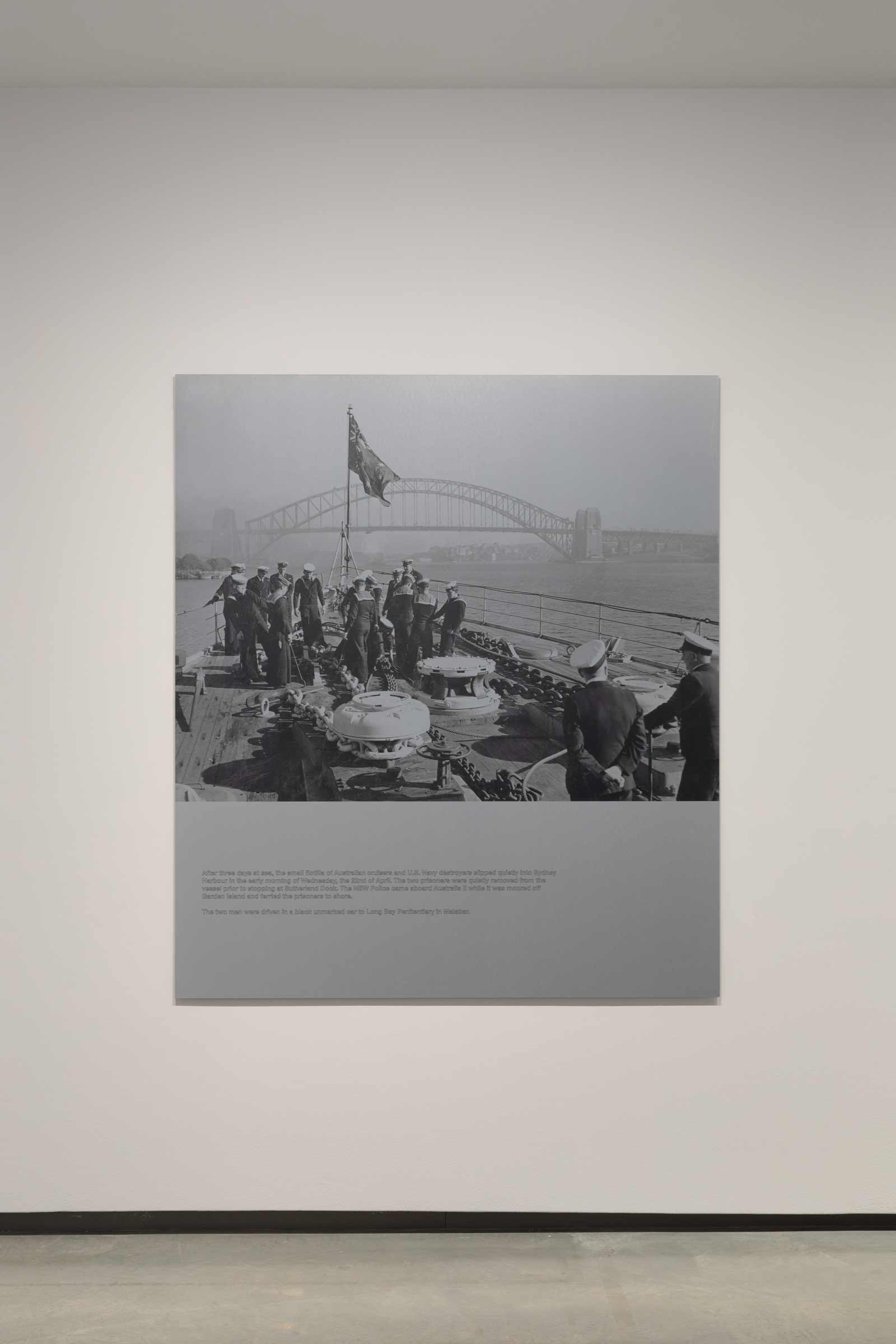
On Flickr, McGrath stumbled across a digital reproduction of official Australian navy painter Frank Norton’s depiction of the upper deck of the Australia II (also now in the collection of the AWM). Upon closer inspection, the reddish hues of the digital reproduction did not match the deep blues of the original and nor did the painting, which is dated 1943, depict the murder or its surrounding events. As a part of this year’s exhibition, curator Antares Wells asked each artist involved in the show to select an object that had functioned as a ‘spark’ for them to be presented at the beginning of the exhibition. The actual painting, on loan from the AWM, hangs at the beginning of the exhibition indelibly marked as a catalyst for the work.
By placing speculative sources against more official accounts of history, and the work of the amateur historian alongside that of the official historian, McGrath raises questions about what makes a source reliable in the first place. Why is it that we are less likely to question the connections made between the more ‘official’ sources reproduced in History Piece? Etched onto a series of ten overlapping glass panels suspended between two columns, in a blue described by the artist as ‘bureaucratic’, are the various sources McGrath has used to reconstruct this history. Many of these were found in the National Archives of Australia, which holds materials related to the trials, while information about the Australia (II) and technical information about the Navy was found in the AWM.[5] McGrath also looked in other places, too; such as historian Robert Hadler’s book Dark Secrets: The True Story of Murder in the HMAS Australia, as well as anecdotal accounts found on the web and the work of internet historians.[6] Whatever the origin of McGrath’s sources, they all have an air of authority to them in History Piece. Perhaps it is the precision of etching itself that gives it such a feeling. Yet, moving around History Piece, some details rise to the surface of the overwhelming sea of information while others become submerged beneath its transparent surface. At certain angles, the very same bureaucratic blue that seems to confer a sense of officiality also bleeds into the rough, deep water of Circular Quay reflected in the mirror behind the glass panels.

Despite the difficulty of achieving a clear view of everything in History Piece, I spent an afternoon watching gallery-goers intensely engage with the work, move away from it, and then, almost invariably, return for another look. As a researcher, I couldn’t help but see myself reflected in this display of determination. We might think of the first look at McGrath’s work as a search for clarity, and the second as an encounter with the messiness lurking behind clarity’s back. This is a quality that extends across the exhibition as a whole: a unifying sense of difficulty between each artist’s work that is nonetheless deeply seductive. One part of McGrath’s work that I think some viewers might find difficult is the terminology they may encounter. 'Homosexual' is not a word that tends to be used much these days. Many prefer 'gay' or 'lesbian,' while many young people have reclaimed the word 'queer.' You may have noticed I have used 'gay' in the title of this response to McGrath’s work, and yet have also used the word 'homosexual' throughout. Why did I do this? One of the challenges of working with archives is deciding how to engage with historical language that no longer reflects contemporary understandings of identity. Having said this, we must also be careful not to transplant our contemporary terminology onto the experiences of people in the past who may not have understood or described themselves in these terms.
The question of terminology is particularly significant to the story at the centre of McGrath's work. There is little reason to assume that Riley, Gordon and Elias would have understood themselves through any of these categories in the ways we understand them today. 'Homosexual' appears in various sources used to reanimate these histories, but this was a term that was thrust upon them through the medical, legal and institutional frameworks that sought to classify their relationship as unlawful. At the same time, to replace it with the contemporary language of 'gay' or 'queer' would risk imposing our own understanding of identity onto them. McGrath's work sits within this tension, asking us to consider the difficulty of finding a way to describe their experiences without pretending that the categories available to us now were available to them.
McGrath made a profound point when we talked about how his work relates to the silences and gaps in the archives: 'The moments that tell you nothing in the work are the ones that are the easiest to see and engage with.'[7] Across from History Piece, reclined against the wall on a shelf, are two smaller works that have an air of silence the other works do not. Their relative quietness is striking after the density of History Piece, as though they are withholding something rather than overwhelming us with it. Here, I am reminded of those unsuspecting sources I have encountered in my own research that do not seem to make immediate sense in relation to what I have already looked at but are nonetheless there.

In Character Pieces, we can clearly and immediately discern the portraits of two women etched onto small panels of glass in that familiar blue, alongside a photograph printed on aluminium of a group of men. The photograph is of the naval board while the etchings reproduce the only images McGrath could find of Blanche Riley, Riley's mother, and Christina Byrnes, the mother of one of his assailants. While it is not the first time we are meeting Christina, as she played a public role in campaigning to remove the death sentence from the two men and subsequently can be seen in various sources in History Piece, it is the first time we are meeting Blanche. Strangely, there is no surviving record of Blanche's perspective on the case. Her absence from the archive is difficult to interpret. Perhaps she chose to distance herself from the story entirely, whether from shame, grief or a desire to protect herself from the public attention surrounding her son's murder. Whatever the reason, her silence stands in contrast to Christina's visible presence in the historical record and this contrast extends to their body language. As McGrath points out, Christina is depicted in motion mid-step and Blanche is represented as resolutely still, looking across to History Piece in cold silence.[8]
History Piece captures a contradiction that I believe all researchers experience while doing archival research: the simultaneous desire for clarity and straightforwardness that the official archive promises, but also for the kind of unruly messiness that leads us down frustrating rabbit holes for hours. The pleasure of happening across just the right document is only rivalled by the pleasure of discovering a gap waiting to be filled. We want the archive to be orderly enough to give us answers, but wayward enough to give us something to discover.
Can we have our cake and eat it too?

Who’s Afraid of the Big Bad Archive? For Those Who Come After
Please be advised that the text contains the names and images of deceased First Nations Ancestors.
As a 'New Writer' – new to art history and somewhere in the chaos of an Honours thesis – I have spent an exorbitant amount of time recently trying to come to grips with the archive. I seek a definition, yet the more I read, the less the archive seems defined by what it contains than by what it cannot. Entangled in all the familiar 'isms' and 'logies', every article, book and seminar frames the archive as amorphous: unstable, unreliable, cruel and yet, somehow, indispensable. If I am honest, I am a little frightened of the Big Bad Archive. It has begun to resemble a mythological beast in my consciousness – a Gorgon of sorts – capable of swallowing lives whole and petrifying them into stony fact. Its authority is bolstered by forms of violence that guarantee absence – absences sanctioned by discourses of power and collective memory. For subaltern peoples in particular, access to one's history is bound to the temporal coordinates of a colonial centre, where absence is a product of the archive's claim to truth.
Primavera 2026: Young Australian Artists initially appears to offer a way to make sense of the archive. Enter expecting archives, and you are certainly given them. The exhibition is organised around the curatorial theme of 'traces,' and at the exhibition's entrance, each artist has offered an object that compelled the creation of their work. The exhibition calls these objects 'sparks': material remnants and synecdochical fragments of the artists' own archives of making, inspiration and encounter that gesture towards narratives larger than themselves. Two artists in particular – Jahkarli Felicitas Romanis and Linda Sok – begin their works with institutional absences, their respective 'sparks' taking the form of a letter-like poem and a catalogue card. Their works inhabit the wounds of the archive: the fractures, displacements and silences that precede them as artists. They challenge the documentary record – the Big Bad Archive as I have come to imagine it – by confronting its monopoly over historical knowledge and its position as the sovereign arbiter of the past. Romanis and Sok offer an alternative approach to history, one that involves a turn towards embodied artmaking with and through family, positing kinship as an alternative historiographical methodology guided by an ethics of care, imagination and reparative practice.
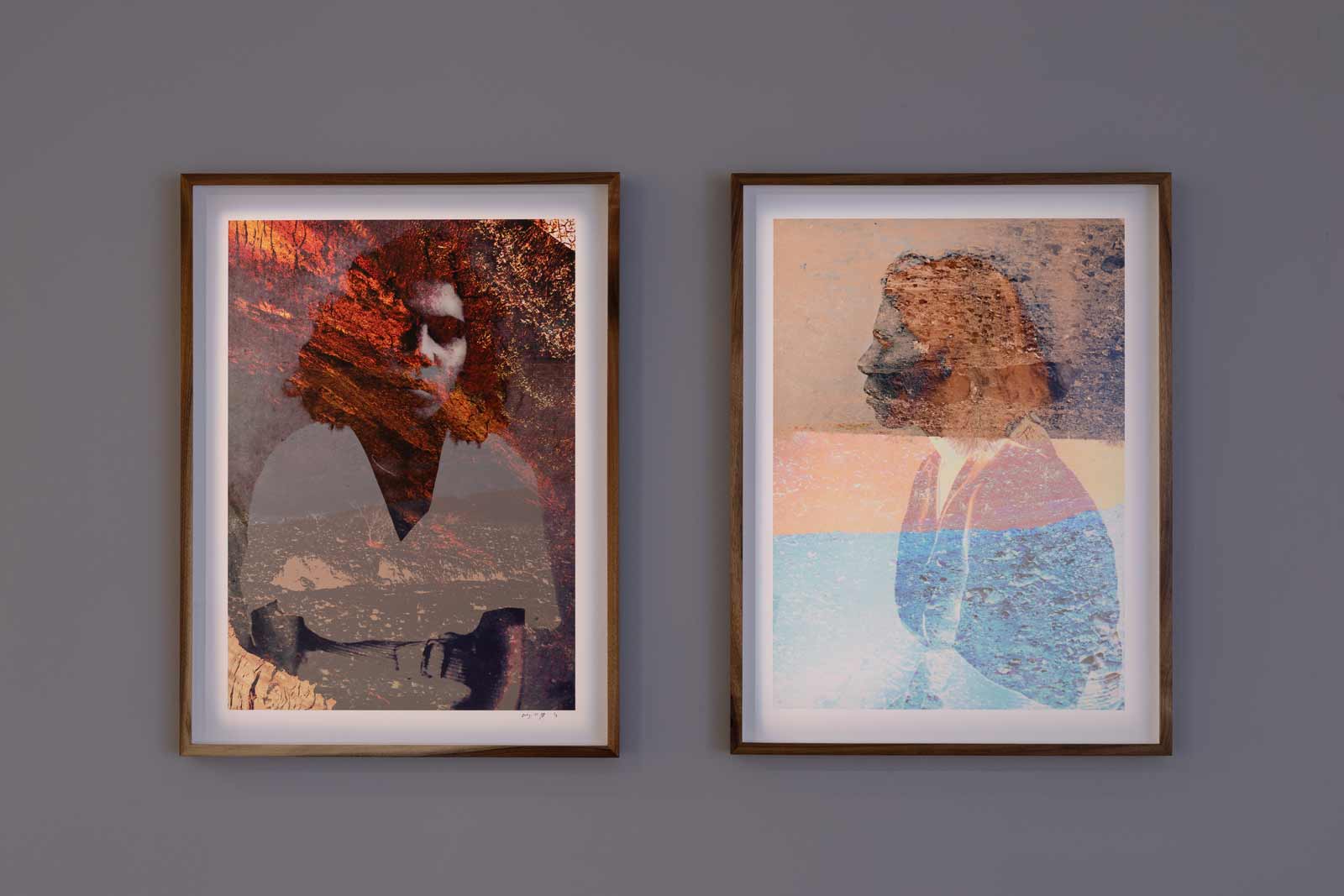
Romanis, a Pitta Pitta artist, begins with one of the archive's most familiar violences: the colonial, ethnographic photograph. The works titled Dolly (2021 and 2024) rework photographs of her great-grandmother, Dolly, 'taken' by Norman Tindale following her forced removal from Pitta Pitta Country to Palm Island. Romanis layers the portraits with her own exposures of Pitta Pitta Country. This gesture of reunion is one of rematriation – an Indigenous women's methodology centred on restoring sacred connections between Ancestral Lands, cultural epistemologies and matrilineal systems. While repatriation often frames return through the recovery of dislocated objects (and thus involves a patriarchal focus on possessions and property), rematriation seeks to restore relationships. In Romanis's work this distinction is made literal: ochres, pale yellows and crystalline blue colour washes seep across Dolly's white dress; weathered escarpments and rocky textures coalesce with the contours of her face and branches of trees emerge from the curls of her hair, all visually affirming the inseparability of Ancestor and Country.
This gesture counters another inherited grammar of history – literary as much as archival – in which family and Country are repeatedly imagined through the language of haunting. The Australian Gothic inherits this fascination with ghosts, projecting settler guilt onto Country by casting the landscape as empty, inhospitable, or already haunted. Aboriginal writer Tony Birch, who has cultural ties to Victorian and Tasmanian mob, dismantles this colonial mythology in his 2019 novel The White Girl. 'Ghosts,' says the book's Aboriginal grandmother Odette Brown, 'are what white people put in storybooks and picture shows.'[1] Romanis's art, like Birch's writing, refuses the consolation of an allegorical haunting. The logic of haunting keeps history unresolved in the present, even as it suggests that violence can be relegated safely to the past. Settler-colonial violence cannot be spectral because it has never ceased. Romanis's care towards Dolly rejects the temporal distance imposed by ghost stories. Her works reconfigure the ways through which Dolly's image was first produced and preserved: as an anthropologised subject fixed by an extractive gaze. Instead of allowing Tindale's photographs to remain as the final record of Dolly's displacement, Dolly insists that presence is ongoing in Country and memory. Dolly is held not as an apparition returning from elsewhere but as an Ancestor whose presence is loved in the present – a presence demanding the responsibilities of the now.
In the accompanying two-channel video Skin to Skin (2026), Romanis stands outside the South Australian Museum, asking where Dolly rests – 'if it can even be called rest' – when she is confined to an archive inaccessible to her family. Alongside her verbal calls to her great-grandmother, Romanis foregrounds the sensory and tactile capacities of the body as a site of sustaining familial bonds across the barriers of life and death. This emphasis on the body as an archive itself – capable of transmitting and affirming presence through touch – finds resonance with Toni Morrison's 1987 novel Beloved. Morrison's Baby Suggs – like Birch's Odette, a grandmother figure – offers self-love as an incisive response to histories of bodily dehumanisation, declaring, 'we flesh; flesh that weeps, laughs … Love it hard. This is flesh I'm talking about here. Flesh that needs to be loved.'[2] In resistance to the violence inflicted on Black and Indigenous bodies, Baby Suggs relocates power to the body itself: its dignity, capacity to feel and stay in relation to others and the world. Romanis indirectly heeds Baby Suggs's injunction to 'love' the flesh – her own and Dolly's. The emotional crux of Skin to Skin arrives in her words:
I remember pushing the oils of my fingers into your skin with these hands of mine that have held my mother’s, that have held her mother’s, that have held yours.
The tenderness of the familial hand conducts a genealogical mode of embodied remembrance, collapsing the distance encoded in the archival photograph through the continuity of touch carried in the living bodies of Dolly's descendants.[3]
As Romanis uses tactility to reach towards her family, Sok enlists hers in an act of speculation, imagining what might be made from the void left by a lost object in Deities in Temples XXI (2026). Sok invited her parents, sister and extended family to respond to a century-old catalogue card from the Musée du Cambodge (now the National Museum of Cambodia). Written by French curator George Groslier, the card briefly describes a Pidan: a Cambodian silk weaving hung above a Buddha statue as a ceremonial parasol, its imagery identified as Divinités dans des chapelles ('deities in temples').[4] This brevity of description is demonstrative of the archive's evidentiary poverty: the card survives in the language of its French colonial cataloguer, while the textile it chronicles is irretrievable. The Pidan's disappearance is likely linked to the looting and destruction of Cambodian cultural heritage under the Khmer Rouge regime (1975-79).
Sok takes the catalogue card – something that might otherwise consign the textile to an 'endpoint' – as her nominated 'spark,' transforming the gaps between what the archive records and what it can no longer supply into a space for collective imagining and participation. She invited her family to draw what they thought the lost Pidan might have looked like, using these speculative drawings as the point of departure for a new material and artistic history. Sok subsequently transferred their drawings onto silk-screens, from which they became the basis for the resulting work: three panels hung at varying heights, where silk and clay form a tapestry-like architecture. Lilac and fuchsia clay links and chains retain the imprints of Sok's fingertips, while fine silk threads descend almost weightlessly, like breath. Across the panels, the family-drawn motifs – palanquins, processions of riders, birds and forest animals – recur throughout. Rendered through a reverse-dye method, the imagery takes on a hazy, diffuse quality, producing a staccato rhythm as figures surface and recede with the viewer's movement around the installation. This flickering visual pulse makes the motifs appear to have been caught mid-recollection, mimicking what I believe is the work's deeper subject – the partiality and mobility of both memory and imagination.
This effect of partiality is not a limitation to overcome but the condition through which the work becomes possible. Neither Sok nor her family knows precisely what the lost Pidan looked like, and without an original against which to measure fidelity, imagination is freed from the task of correction and necessarily employed as a generative means of cultural preservation. Saidiya Hartman names this task as the attempt to 'tell an impossible story and to amplify the impossibility of its telling.'[5] For Sok, the task of telling an 'impossible story' carries particular weight. Given that she is the daughter of Cambodian refugees, her family are themselves connected to the history that the catalogue card is a remainder of. Theirs is a project of agency rather than approximating authenticity: a willingness to let the inflection of witness coincide with the liberties of invention, culminating in a work that is ultimately remedial and, simply put, very beautiful.
The Big Bad Archive is still Big and Bad. But Primavera 2026 – Romanis's and Sok's works especially – made clear that everything I thought I needed to know about the archive's meticulousness – its aggrandising literatures, its 'isms' and 'logies' – matters less than the people who continue living in its wake. We are to continue making archives today. Both artists work as tender daughters, turning their duty to loved ones and cultures into methods of historiographical repair. Encountering their work, I was urged to think of my own family and cultural history, and of where an archive of my own might begin. If the archive, as we know it, is only a very skewed recollection of the past, then our duty as contemporaries – New Writers and Young Artists alike – is to question it, and answer as plainly as we can: history belongs to us, in memory, in family and in love.

What Country Remembers: Country as an Archive as Seen in the Artworks of Jahkarli Felicitas Romanis
Please be advised that the text contains the names and images of deceased First Nations Ancestors.

I have been taught that Country is an entity that gives me life, and holds memory and my Ancestors. In many ways, Country is archive. Walking into Primavera 2026: Young Australian Artists at the Museum of Contemporary Art Australia I was drawn to the work of Pitta Pitta artist Jahkarli Felicitas Romanis. Her photographic and video works Dolly (2021), Dolly (2024) and Skin to Skin (2026) resonated with my own understanding of how Country holds and remembers our Old Peoples, while confronting the violence and limitations of the Western archive and museum. Guided by Country, Romanis explores her connection and longing for her great-grandmother, Dolly, whose photographs are held in the South Australian Museum’s Norman Tindale Genealogical Collection. Romanis disrupts Western and settler-colonial ideas of place and time, challenging colonial museum practices, collections and institutions by reconnecting with her Ancestors and Country.
I am a proud Wiradjuri and Gomeroi woman with ties to Yuin Country. In this essay, I will draw from my own cultural knowledge, experiences, Cultural Teachings, and connection to Country. I can only speak for myself, and where appropriate my family and community.
Country, containing the Land, Sea, Sky, Dreaming, Songlines, kinship, people and beyond, is at the centre of Aboriginal cultural knowledge and practice.[1] My understanding of Country includes Mother Earth, Father Sky, Grandmother Moon and Grandfather Sun – all are living entities and hold memory. Country is alive and has acted as an archive since time immemorial. Most importantly, I am Country and Country is me. Self and Country cannot be separated; they are one thing, one entity.
Archives tend to hold Aboriginal cultural materials that have been stolen by the white anthropologist and settler, without the consent of the communities to whom they belong. This includes the theft of our Old Peoples, who exist not only as Ancestral Remains but also within photographs, film, sound and objects. For many Aboriginal peoples, the archive is therefore not confined to the past; it holds ongoing connections to Ancestors, Country and the present. For us mob, we don’t only have a strong connection to our cultural material held in Western archives, it is that we are those collections.
The photograph of Romanis’s great-grandmother, Dolly, is not just a photograph. It is physically and spiritually Dolly, and Country has archived her memory throughout the landscape.[2] The two photographs in Primavera are reworked scans of the original photographs taken of Dolly by the anthropologist Norman Tindale in 1938.[3] These photographs would have originally been captured for ethnographic purposes, dehumanising Dolly for scientific means. Dolly was forcibly removed from Pitta Pitta Country in central-west Queensland to Palm Island, as part of government control over Aboriginal peoples.[4] The reworked photographs are displayed next to a video-work of Romanis speaking directly to Dolly.
When Romanis last sought to access the photographs of Dolly, the South Australian Museum denied her access, citing a collection move as the reason.[5] Dolly’s whereabouts were unknown at the time due to this apparent move. This highlights the control and colonial authority museums continue to exert over cultural material and Ancestors, restricting Aboriginal peoples from accessing, being with and caring for our own Old Peoples. While Romanis’s work is deeply rooted in her personal connection with Dolly and Country, it also exposes the broader tensions between Aboriginal peoples and museums, particularly around the questions of who has the power to access and care for our Ancestors and cultural histories.
PLACE
Place holds the memories of our Old Peoples and histories. Despite the dispossession of our mob because of colonisation, we are connected to Place through kinship and Songlines. Our Ancestors are often found in the Land as Country is archiving them. For myself and my family, we find my grandfather, Brian, in the ibis, and when we see one, we know he is looking out for us. In an anonymous survey about connections to Ancestors, one participant stated:
My mother passed … I would find her in the bush that surrounded my home, or in a lady satin bird that always landed on the kitchen windowsill and peered in at me. But mostly, I would find her by the river. These places always felt ancient. Berry is ingrained in my body and I am connected to this place. I could feel that these places had sheltered many before me.[6]
Aboriginal peoples have connection to Place through our Ancestors, and Place is how we remember our Ancestors.
Romanis’s great-grandmother was removed from Pitta Pitta Country, but Dolly would have remained one with the Land as Country remembers her. In Dolly (2021) and Dolly (2024), Romanis uses scans of Tindale’s photographs of Dolly and removes the ethnographic markings and number card that accompanied her into the South Australian Museum.[7] By stripping away these identifiers, Romanis repositions Dolly as a person rather than an object of ethnographic study, challenging the colonial gaze through which she was originally photographed and archived. In a poem about Dolly that accompanies her work, Romanis expresses that Dolly is her great-grandmother, ‘Nothing more, and nothing less.’ She is not something to be studied by the colonial anthropologist, she is a person.
Romanis has embedded Dolly within photographs she took while on Pitta Pitta Country on two separate occasions.[8] Rather than depicting a single image of Pitta Pitta Country, these works layer multiple photographs of different sites across Country with Dolly.[9] Romanis connects Dolly’s presence in 1938 with the present day, layering photographs taken across Pitta Pitta Country over her image to create a visual connection between these different moments in time. Despite the passage of linear time, Dolly remains connected to Pitta Pitta Country. Dolly can be found in the landscape, and the hold of the anthropologist is removed. This is no longer a scientific photograph but a reclaiming of Old Peoples who have been stolen by anthropologists and museums. In their 2006 book Treading Lightly Karl-Erik Sveiby and Tex Skuthorpe explain that for the Nhunggabarra people of south Queensland and northwest New South Wales the land
... was full of symbolic images reminding them about creation, immortality, sacred law, and most significantly, their role within the cosmic process itself. In a very deep sense, the land was a meaningful part of the people just as the people gave symbolic meaning to the land.[10]
Romanis and Dolly have an unbroken connection to Pitta Pitta Country. The viewer has to search for Dolly within the photographs, as she is deeply embedded within Country. Romanis is not just reconnecting Dolly with her Country but also with the Ancestors that would have shaped the land with both stories and performances, and with everyday activities.[11] The images of Pitta Pitta Country may be Places where Romanis has felt or seen Dolly. Romanis is continuing this trail through her work by creating new memories of Dolly and returning her, as much as she can, back to Country.
TIME
Aboriginal understandings of time differ from the Western and settler-colonial concept of linear time. Linear time is seen as a straight line; there is a beginning and an end. However, in many Aboriginal cultures, time is seen as a circle. The past, present and future are all happening at the same time, meaning we are living and sharing Country with our Ancestors in this very moment. Apalech author, Tyson Yunkaporta explains that we
... experience time in a very different way from people immersed in flat schedules and story-less surfaces. In our spheres of existence, time does not go in a straight line, and it is as tangible as the ground we stand on.[12]
The imposition of linear time does not separate our connection to our Ancestors and the dispossession they experience.
Skin to Skin responds to the photographs of Dolly and explores the impact of her presence within the archive on Romanis and her family. In 2022, Romanis spent time with Dolly, holding her and feeling as though she was holding her.[13] Romanis was not only holding the physical photograph of Dolly but the spirit of her great-grandmother. The experience ‘carried the weight of her journey, her stories, her spirit, bridging the temporal and physical distances between us. It felt like we had found each other.’[14] Linear time is not a factor in Romanis’s relationship with Dolly. Romanis challenges the notion of linear time by placing herself in Dolly’s position, mimicking the ethnographic pose Dolly was made to perform for Tindale, and even wearing a similar blouse. Through this act of temporal and embodied connection, Romanis collapses the distance between herself and Dolly, bringing their experiences into the same moment.
Although Romanis was denied access to Dolly, in Skin to Skin she speaks directly to her, filming outside of the South Australian Museum. Romanis is reminiscing over the last time she saw Dolly in 2022 recalling, ‘I remember pushing the oils of my finger into your skin.’ This connection is not constructed through linear time. Yankaporta describes time as a ‘beautiful way that was right now, where now-time was all-time and filled with joy.’[15] Romanis’s relationship with Dolly similarly collapses the boundaries between past and present, allowing Dolly’s presence to exist within Romanis’s present experience rather than remaining confined to the historical archive. Romanis’s experience of seeing Dolly and holding her is a time of joy, where the past intersects with the present. Country collapses the temporal distance between generations, allowing a relationship with our Ancestors through visual communication in the Land.
Skin to Skin is a matriarchal work. It explores the intergenerational female relationships between Romanis, Dolly and Romanis’s mother. Romanis is connected to Pitta Pitta Country through her mother.[16] Although the work is attributed to Romanis, it was created collectively, with Romanis’s mother present during the filming alongside a small crew.[17] Her mother’s presence is significant, as she too sought to reconnect with her grandmother, with Romanis expressing this desire on behalf of her mother in Skin to Skin: ‘She really wanted to see you.’ During each take, Romanis asked the crew to leave, allowing her to speak directly to her mother and Dolly. In the film, Romanis reminisces about holding Dolly, reflecting on the intergenerational connection between herself, her mother, her grandmother and Dolly: ‘with these hands of mine, that have held my Mother’s, that have held her Mother’s, that have held yours.’ Through this gesture, Romanis traces a lineage of touch across generations, connecting herself to Dolly through the embodied memory carried by kinship. For a non-Indigenous viewer, this connection may be difficult to understand when Dolly appears to be only a photograph. However, for Romanis, Dolly represents an ongoing connection to kinship that extends across generations and encompasses all time.
Dolly (2021), Dolly (2024) and Skin to Skin (2026) move beyond Western understandings of the archive. The works challenge the ongoing harm of museums as institutions that have historically taken from Aboriginal peoples while denying them access to their own cultural materials. At the same time, they explore complex Aboriginal understandings of time, kinship and being, in which Ancestors remain present and alive despite the Western construction of linear time. Ultimately, Romanis reveals how we as Aboriginal peoples consider Country to be our own archive. Our histories, stories and Old Peoples are forever remembered within the landscape, waiting for us to hold them.
ABOUT PRIMAVERA:
YOUNG AUSTRALIAN ARTISTS
Rewrite
On Art and the Archive
Thursday, 10 September 2026
6:00pm–8:00pm
MCA Australia
Responding to MCA Australia’s current exhibition Primavera 2026: Young Australian Artists, the 2026 cohort spent three months working with mentors Antares Wells (MCA Australia), Nick Croggon and Daniel Browning (The Power Institute), taking part in artist talks, writing workshops, reading groups and studio visits.
Leighlyn Aguilar
Aiden Magro
Anthia Balis
Sasha Blackman
Sarah Clayton
Bineeta Saha
